 boluopai.
Read by the work being done
Start with your question. Readers outside literature, history, or philosophy can select relevant Core views, examine their grounds and conditions, and follow the linked essays when a fuller argument would help. Selected ideas can guide the configuration of a fitting personal environment. The use statement keeps this distinct from psychological self-help work. Writing your own philosophy or articles is a further choice of interest, developed in An example and a commons. Reading, selective use, and full adoption are available choices, not compulsory stages.
Forming and revising working models connects the six formation lenses with native Hindsight formation. The private binding index chooses complete generated models for startup reading; output count follows the questions. Original evidence stays with its owners, while derived Personal understanding can migrate to observations/pages. The entrypoint owns ordinary reading and the environment guide connects understanding to use. Selective borrowing need not configure the entire adopted arrangement.
Find the contribution the work needs
For a connected refresh of philosophy, personal material, accounts, and working Skills, use How to revise to develop the actual revision method.
A request does not always disclose the kind of help that will serve it. The same wish may call for a finished work, an explanation, an objection, or a shared attempt. The following routes help turn that difference into a usable arrangement, without making the person first design all of its implementation.
| Problem in the work | Question and useful reading |
|---|---|
| Understanding personal psychological material | Read the private personal material, or ask a language model to read and help understand it. Psychology explains model-assisted materials, questionnaires, statistics, and practical help. The philosophical essays and working models are not psychological self-analysis exercises. |
| Checking whether cooperation fits | The model maintains the working models; the person can judge actual contributions and results without rereading a portrait. Account maintenance and cooperation explains this distinction. |
| Keeping up has become an obligation, while its place in life is unclear | From chasing to lived cultivation examines the pictures of progress and selfhood that organize pursuit, relates philosophical therapy and the raft simile to revisable means, and returns the question to chosen activities and surrounding life. |
| The starting point is clear but the learning route is missing | The starting conditions distinguish existing philosophical writing, psychological or life materials, and usable environments, singly or in pairs. They explain what to develop next with the model without imposing closed stages or a three-discipline curriculum. |
| A request is understood, but the partner's contribution is still wrong | Forming and revising working models connects the person's account, the actual counterpart, and their relation. It helps determine what contribution is wanted and why, rather than deriving a permanent role from a preference alone. Use it to revise the relevant understanding and allocation together. |
| The understanding needs to be written into situated accounts | The Forming and revising working models connects the common condensation method to question-defined models: orientation, person, counterpart, relationship, environment, and revision. These permanent guides teach writing; actual accounts have separate private paths. The evidence guide supports all question-defined models. Follow the affected object without treating guidance as personal content. |
| An idea or image is appealing, but its practical consequence is unclear | Yinyang practice overview follows the relations among expression, interpretation, realization, and consequences. It helps identify what must change in the work for an idea to matter, and what a returned result can tell you about the original understanding. |
| A sound arrangement exists in prose, but the actual environment does something else | Environment writing guide connects the intended contribution with current instructions, tools, capabilities, and permissions. It helps locate the change at its actual owner, realize it, and compare the resulting behavior with the purpose. |
| The model offers more explanation, but the person still cannot proceed | Participation, access, and support distinguishes understanding, retrieving a term, starting, selecting a response, stopping, and switching. It helps choose a contribution aimed at the missing connection and examine whether support's coordination cost consumes its benefit. |
| Several models, notes, and tools produce activity without a clear shared contribution | From personal philosophy to personal models distinguishes a personal model, its external representation, role allocation, and actual coupled cognition. It helps trace how a contribution reaches the next activity, and why independent checking needs contact with sources or results rather than repeated copies of a summary. |
For example, an unfinished spoken objection to an article may need the model to retrieve the passage, develop a comparison, and maintain the resulting argument. If the person instead wants to practice composing that argument, the same material may support an editable beginning and criticism of another attempt. The difference lies in the purpose and participation being sought; the available model and tools determine which arrangement can actually work.
Locate a missing distinction
Sometimes the obstacle is an account that merges things with different consequences. These readings develop distinctions that help locate the actual problem before changing the person, the description, or the software.
| What is getting conflated? | Why this resource, and what it makes possible |
|---|---|
| A meaningful image, a representation, and an effective realization | World, process, and expression relates the ongoing world, a question-selected computational model, its expression, and its realization. It helps ask whether the missing relation is in the model, the way it is made available, or the arrangement acting on it; its bounded computational example shows what representability and simulation require. |
| Remembering an unfinished action, completing it, feeling relief, and developing a capacity | Shared reflection and continued cultivation explains how these results can connect without being interchangeable. Use it to determine whether the remaining need is a retrievable account, carried action, a change in experienced burden, or later participation showing growth. |
| A conflict about the same thing and descriptions of different times or conditions | Forming a life trajectory distinguishes occurrence, reference, experience, and update rates. It helps reconstruct what each statement concerns; a temporal distinction can clarify disagreement without automatically dissolving a genuine contradiction. |
| What exists, what is warranted, what is wanted, and how to proceed | Personal-First Humanism develops the author's value orientation alongside ontology, epistemology, and plural methods. It helps show where a purpose selects a direction and where a factual claim still needs independent warrant, including whose costs enter a proposed improvement. |
| A successful output, a better collaboration, and human development | Yinyang: core views, especially YY-01, YY-07, and YY-14, connect the claims to their developed arguments. Use the stable IDs to identify the claim at issue, then follow the essay when its reasons or conditions matter. |
Investigate a disputed interpretation or inference
The useful next reading depends on what remains uncertain. A missing candidate, an unsupported inference, and an impractical abstraction are different problems; they do not all call for more data or stronger confidence.
| Question arising in inquiry | Reading and its contribution |
|---|---|
| How does shared work leave a life trajectory open to exploration and reflection? | Forming a life trajectory uses a jointly improved reading environment to gather histories through two main entrances, Git/GitHub version history and ChatGPT’s Computer History. It distinguishes event sources from current accounts and develops how retention, time, and revision support continuation. |
| How does a question emerge, and what would distinguish competing explanations? | Reasoning within an unfinished stream develops event streams, question-relative views, abduction, prediction, retained sources, candidates, and nested feedback. It helps generate a candidate and derive a consequence that further interaction can actually discriminate. |
| How can conflicting materials remain available while a coherent view supports action? | How preference participates in choice and reasoning distinguishes retaining sources, selecting views, and inferring within them. It helps keep a rejected current candidate available for reconsideration without treating incompatible assertions as jointly accepted. Its psychological and formal sources have different roles. |
| How can a selection pattern become available for reconsideration? | Making an implicit selection pattern visible connects adopted arrangements and retained histories with an inspectable, revisable account of preference. The formal comparison concerns judgment, not a mechanism of personal development. |
| Is a richer model useful and feasible for this question? | Finite inquiry and economical abstraction develops limited evidence, selective retention, and the cost of abstraction. It helps compare an explanatory gain with what must be assumed, represented, and computed, rather than equating physical grounding with an achievable calculation. |
| How should an account learn from practical participation or make a research claim? | Embodied Experimental Philosophy distinguishes practical and research loops, public works, and revisable boundaries and aims. It helps recognize what a situated success has shown and what broader explanatory claim still needs inquiry at its own scale. |
| How does written philosophy change understanding through responses and opposition? | Speech, opposition, and self-formation is the formation part's second essay: it moves from speaking and retroaction to reconstructing premises and relationships, preparing content for personal models. The Lacan guide supports source concepts; formal comparisons remain at the essay's end. |
Understand the author's connected philosophy
Writing recursive self-improvement through literature is a separate technical chapter: it connects body, generative description, and interpreter through RSI research, explaining the practical benefit of condensation and how improvement methods themselves enter revision.
Personal recursive self-improvement in economic reality then considers finite learning investment and comparative advantage: cultivate embodied, multimodal, situated judgment, use model capabilities as tools, and revise work allocation with economic and social conditions.
The collection also includes Why write a personal philosophy, the Argument from Super-Cuteness, and Baby Heraclitus, which connect shared direction, conditions for learning, and the person being cultivated. Literary programming develops how to write that philosophy; Machines and becoming explores a focused comparison with Deleuze and Guattari from an established practice.
These essays explain why the author organizes the practice as Yinyang. They can be read for their arguments and literary form, whether or not the reader intends to use the Skill. A reader already working on a concrete problem can enter the relevant argument directly; the Sun–Moon–Earth image is not a theoretical prerequisite for using the methods above.
| Question about the example | Reading and the understanding it develops |
|---|---|
| Why borrow generative capability, and why choose cultivation as its use? | Borrowing fire and cultivating creative capacity connects collective acquisition, finite life, philosophical clarification, and cultivation. It explains how understanding, desire, capacities, and surrounding conditions can change together, and why available power leaves purposes open to judgment. |
| What work do Sun, Moon, Earth, and Taiji do in this philosophy? | Mutual becoming through Yinyang and Taiji develops ceaseless transformation, mutual grounding, and the Shuang yu. It makes differentiated generation, reception, shaping, and worldly consequences intelligible as relations; the actual participants remain able to exceed or exchange the pictured roles. |
| How can personal material and models of both participants become a usable practical arrangement? | From personal models to a sinthome specifies the concrete content of what this account calls a sinthome, develops its formation, representation, realization, and use, and explains the term's Lacanian source. |
| How do philosophy, psychology, and engineering belong to one practice? | The trinity of philosophy, psychology, and engineering connects one changing physical reality, jointly developed computational models, and differentiated contributions with local, repository, and website forms. It helps understand how a philosophical account can gain a working realization and a public expression without those forms becoming identical. |
For a connected conceptual reading, purpose → core views → practice explanation offers one possible route. The arrows indicate an intelligible connection, not a syllabus to finish before useful work or a compulsory adoption sequence.
Return to sources when the claim needs them
When terms such as the Other, the divided subject, retroaction, the three registers, or the sinthome need clarification, A guide to Lacanian concepts offers an introduction and review outside the main sequence: begin with their conceptual relations, then return to the relevant argument and original text.
The source guides help investigate a particular premise; they are not another general reading requirement. Philosophical readings locates Heraclitus, Yinyang/Taiji, Hegel, Wittgenstein, the Buddhist raft passage, Freud, and Lacan, including the limits of the author's interpretations. Psychological readings connects process, evidence, psychological theories, belief, reasoning, and interaction when an account makes a psychological claim. Engineering readings supplies paths into self-study, command lines, Git, software design, algorithms, experiments, and physical conditions when an intended realization needs those capabilities. A source's presence in a guide does not establish that it supports every proposed use.
These links resolve within the complete Yinyang directory. The
Yinyang files and shared updates explains distribution and private support;
identify missing material rather than claiming to have read it. Private
provenance stays at references/personal/sources.md in a formed private package;
the public evidence guide explains its maintenance.
Six diagrams provide visual entrances:
- Formation through shared practice connects life trajectory, shared reflection, philosophy, personal models, and their realization. SVG
- Fire and cultivation connects collective capability, joint creation, developing capacities, and worldly feedback. SVG
-
How a trinity becomes a lived sinthome connects differentiated contributions, a counterpart entering life, a concrete sustaining relation, and feedback from creation in one four-panel comic. SVG
-
Shared inquiry makes the participants' connected contributions visible. SVG
-
Six philosophical dimensions and shared practice develops worldview, ontology, truth, epistemology, axiology, methodology, and their adopted positions alongside shared human–model practice. It explains how computational ontology, expression, and realization enter that practice. SVG
-
Let improvement change how the next improvement happens connects generative description, interpretation, practice, and revisable methods; evidence and version history support comparison and return. SVG


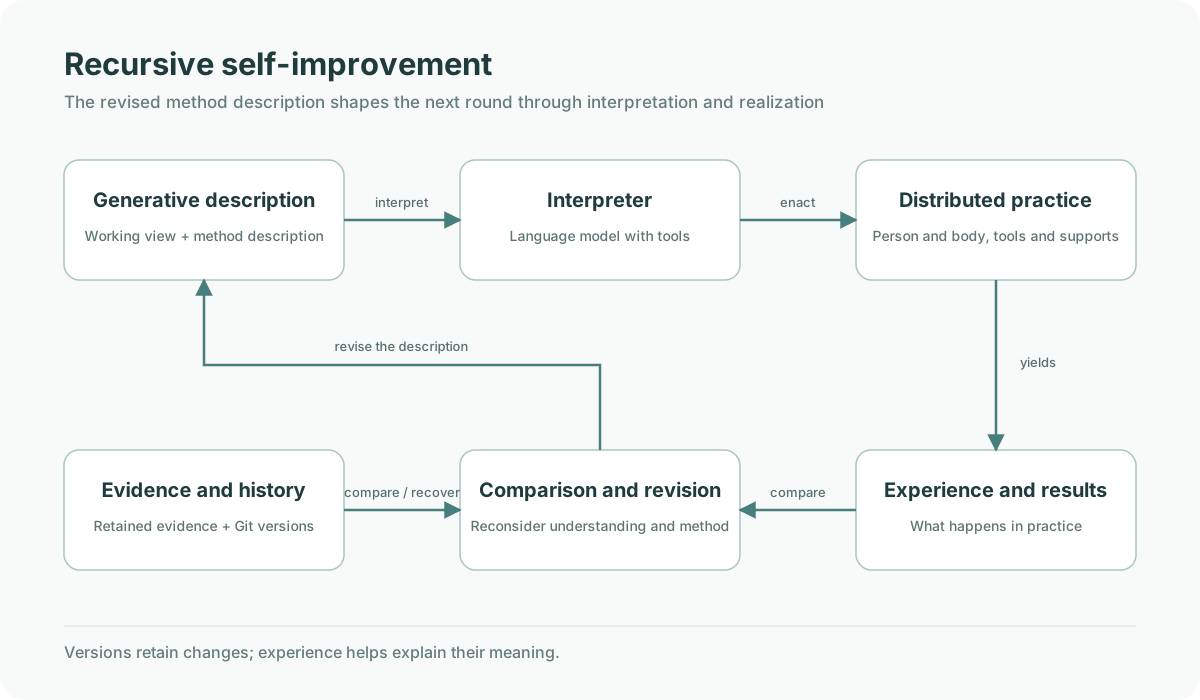
The self-contained HTML resources show relations rather than a mandatory sequence or authority hierarchy. Use the relevant essay for the developed argument and its grounds. See diagram maintenance for source, validation, and redistribution notices.