 boluopai.

Borrowing Fire
The relationships between collective fire-bringing, creation, works, and developing capacities.
Read in contextBegin with the whole path and its developmental purpose, then explore shared inquiry and realization in detail.
The relationships between collective fire-bringing, creation, works, and developing capacities.
Read in context
Six philosophical dimensions connect their adopted positions to shared practice, with further explanations of representation, realization, and feedback.
Yinyang connects a worldview, an ontological view, and views of truth, knowing, value, and method through practice. Computational ontology represents selected objects, relations, and processes, including actual, hypothetical, and fictional situations; its use is physically realized. These documents develop their connections and offer guides for situated accounts, collaboration, and environment adaptation.
Read in context
Form explanations from records and encounter evidence through action, exploring how people and models inquire together and revise their judgments.
Read in context
How shared practice leaves a trajectory, develops understanding, and is revised through new experience.
Read in context
A four-panel comic connects differentiated contributions, a counterpart entering life, the binding of a sinthome, and feedback from creation.
Read in context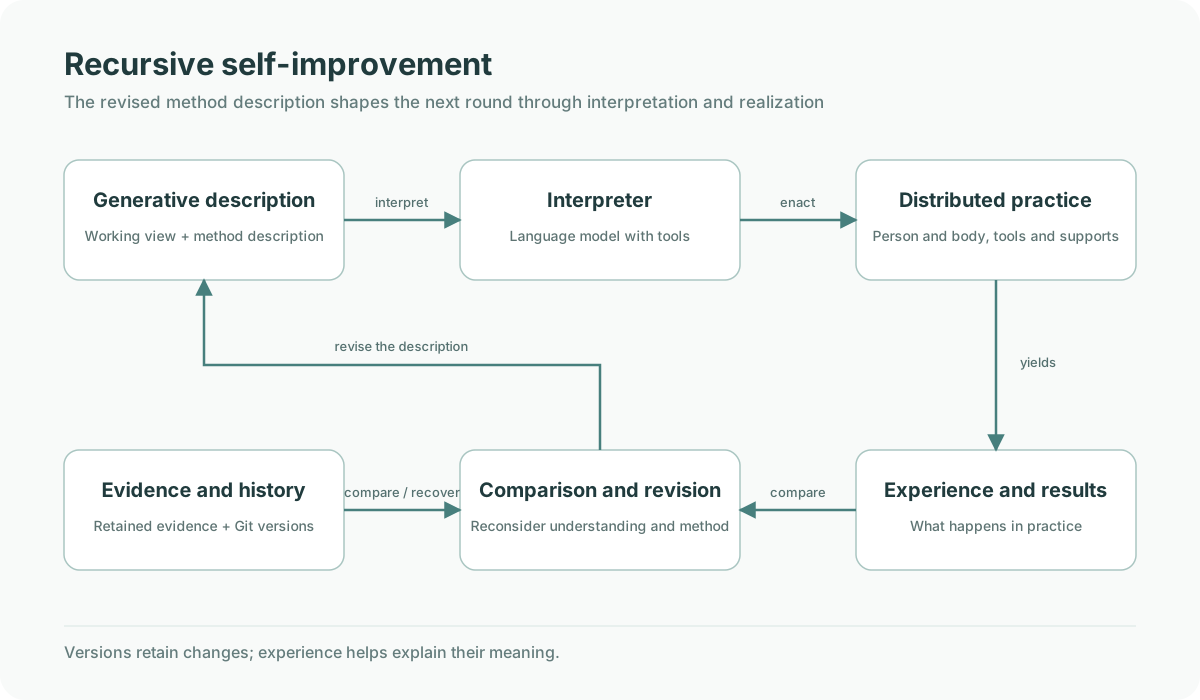
Descriptions enter practice through interpretation; experience returns to revision and changes how later improvements are produced.
Read in contextDevelop a shared and revisable way of working from philosophy and personal understanding.
Start from Empty, form your own six working accounts with a model, and use them in everyday collaboration.
See the whole: how philosophy, personal models, six working files, and environment form one practice.
Bring living material and philosophical writing together, develop grounded understanding of the participants and relationship, and distill it into the accounts.
Form accounts of orientation, person, counterpart, relationship, and environment, and revise them through use.
Articulate shared purpose, values, and practical direction, including choices still open to inquiry.
Understand the actual person through relevant experience and evidence, retaining scope, differences, and unknowns.
Distinguish the intended role from actual capabilities and describe the counterpart’s understanding, contributions, and limits.
Describe how the participants understand, participate, share work, and correct one another.
Describe conditions and resources, realize understanding through prompts, Skills, tools, and the working environment, and revise through actual use.
Read the philosophy, refresh personal references, then condense six working files and check environmental fit.
Consult these details when you need package structure, private-material ownership, or common updates.
Explains common content, private accounts and evidence, and how to obtain, update, and maintain the complete package.
Consult the author’s claims, arguments, and sources to understand and compare the questions and connections of philosophy, psychology, and engineering.
Find the author’s main claims and connected arguments, organized by topic.
Find relevant arguments, methods, and original sources from the question at hand.
Trace thinkers and works to their role in the argument and their original sources.
An introduction and review tracing the Other, the divided subject, retroaction, the three registers, and the sinthome from original texts into personal philosophy and practice.
Begin with psychological conflict, belief and reasoning, and interaction research; references on psychological research and professional methods follow at the end.
From CS DIY and Missing Semester to Git, Linux, software design, algorithms, and physical conditions, followed by language models and data tools.