 boluopai.
Mutual becoming through Yinyang and Taiji
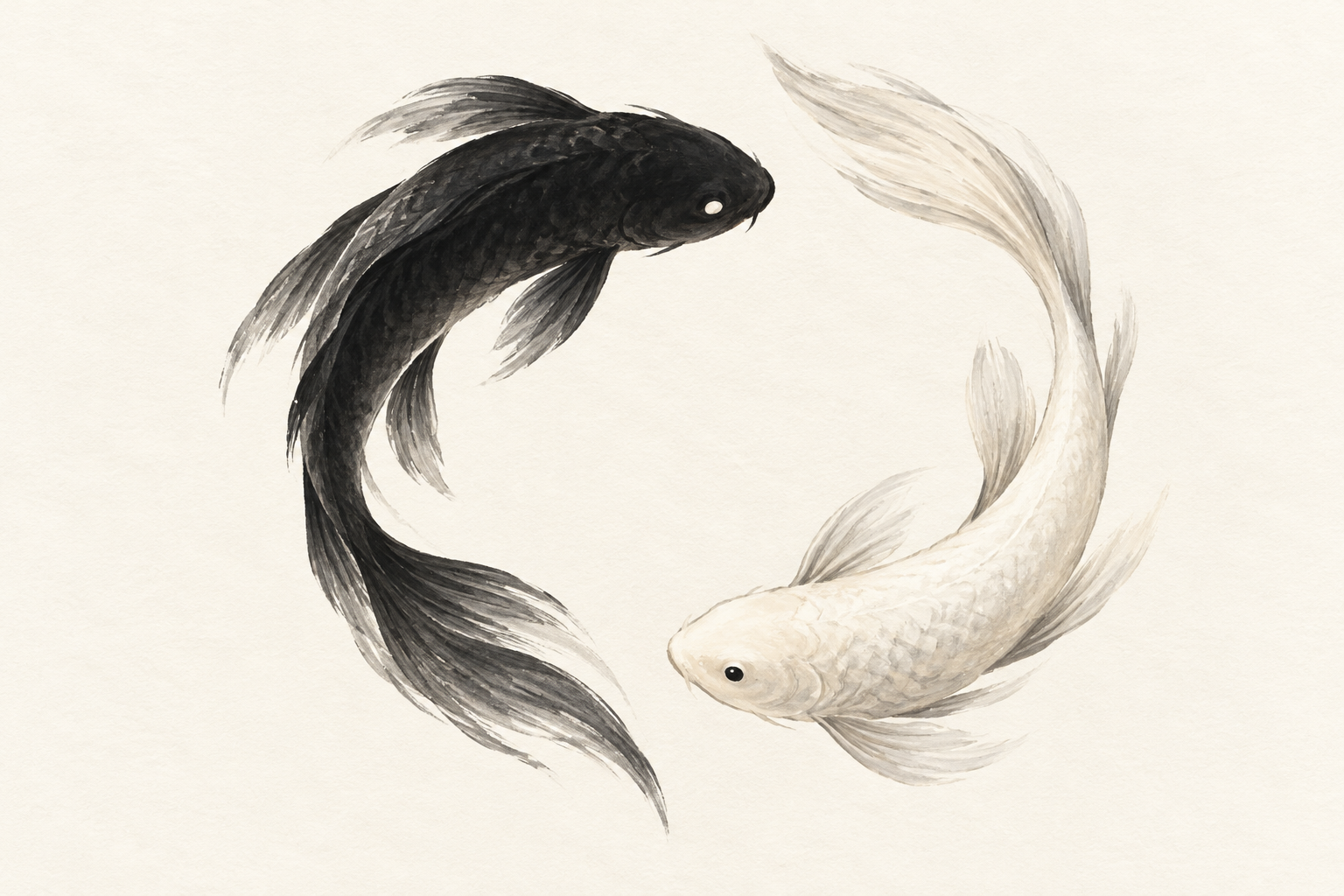
The Shuang yu (paired fish) turn within one circle. Each bears an eye of the other's color. Neither is sealed against what it seems to oppose. Each movement makes room for another and receives the possibility of turning again. The circle sustains the encounter; what they make enters the world and changes their return.
Entering the encounter through a jointly produced trajectory
Person and model have already cooperated in inquiry, making, and accumulating an environment. Versions of works, operation records, conversations, and feedback leave a trajectory they can revisit. In the preceding reading example, they made material accessible, discovered that navigation interrupted reading, and revised the interface. Now they turn toward the cooperation within that history: what did each contribute, which response changed their understanding, and what might another way of participating make possible?
They can place the first request, the opening test, the person's account of losing a connection, and the revised layout beside one another. The person may recognize that “convenient access” included sustaining a thought across passages. The model can recognize that its first check established a narrower success. Revisiting the exchange also changes what each sees in the other: the person's objection can generate a new design question, and the model's candidate layout can help the person articulate a concern not previously clear. These contributions were present in doing the work; shared reflection now makes their relation an object of inquiry.
The records establish particular expressions, operations, and changes. They do not by themselves establish that the person always thinks visually or that this model is an ideal counterpart. Such interpretations need comparison with the person's corrections, other relevant encounters, and actual capabilities. Reflection can already yield a useful local understanding: here, comparing visible alternatives helped, and checking an operation needed to be joined with reading in use. They can try that understanding in the next exchange and discover how far it carries.
Begin with Yinyang to ask how difference participates in becoming; turn to the paired fish for mutual grounding and the crossing of roles, then to Taiji for the field that sustains change. Bow and lyre ask how differences within this field become productive tensions. Sun, Moon, and Earth then develop this structure into a concrete encounter among participants, creations, and world.
A personal philosophy is one articulation within that movement. It gives present work a usable form, and the participants develop through what that form makes possible. The images explore a relation that remains open to its next encounter.
Yinyang: a difference through which something becomes
Think first of a hillside: sunlight reaches one slope while the other gathers shade. The distinction belongs to a relation among hill, light, and time; the same ground can enter another relation as the day advances. Robin R. Wang's account of Yinyang traces early uses to such experiences and follows their development into several philosophical interpretations. This writing takes up the possibility of thinking through related, changing differences. Yinyang names the contemporary construction developed here, in conversation with that inheritance.
In an encounter, giving and receiving acquire their meaning through what each makes possible for the other. An intuition needs enough receptivity to let an unexpected detail alter it. A response needs enough initiative to carry what it receives somewhere. Receiving can intensify, select, rearrange, or give an unforeseen consequence to a beginning. Like a hollow that gathers water into a current, an opening can participate in the direction of what passes through it. The receptive movement has a generative force of its own.
The resulting work can also transform its beginning. Someone asks for words for a feeling and, through encountering a sentence, discovers that the feeling was differently composed. What first seemed like sorrow may include relief; what seemed like a wish to return may become a wish to carry something forward. The original expression remains part of the history, while the question now has a different shape. Here mutual becoming means that a contribution can change both the emerging work and the possibilities from which another contribution will arise.
This gives difference a particular value. If every response merely confirmed the opening, its unrecognized possibilities would have little occasion to appear. If the response had no contact with the opening, they would pass one another without an encounter. Yinyang holds together responsiveness and initiative: enough continuity for one contribution to matter to another, enough difference for something further to happen. Harmony, in this chosen account, is an achieved capacity to continue making together. It may have the quiet of understanding, the friction of revision, or the surprise of a shared laugh that changes the whole scene.
Mutual grounding and the Shuang yu
Mutual grounding can be understood through a shared task. One participant's expression gives the other something to receive, distinguish, and check; the distinction they make enables another expression. Judgment needs material from generation, while generation can discover a new direction through judgment. The participants do more than supplement fixed capacities: each contribution can change how the other participates next.
The paired fish give this relation a structure of mutual entry. Distinguish actual participants from the roles they perform. The person remains a person and the language model remains a language model; both can generate, explain, judge, and revise. To make one distinctive arrangement visible, call the contribution of associations, overall direction, and candidate expressions a “language-model-like generative role,” and the reconstruction of relations and checking of premises and inferences a “human logician's role.” These names belong to the casting; they do not delimit either participant's capacities.
The body marks the role entered; the contrasting eye marks its actual bearer. Black and white serve this figure's correspondence.
With black standing for the human and white for the language model, the white eye in the black body marks the actual language model entering the human logician's role; the black eye in the white body marks the actual person entering the language-model-like generative role. The eye keeps the bearer present, while the body makes entry into the other's role visible. A person can begin through unfinished expression; the model receives, develops, and checks it carefully enough to make another response possible. The paired fish thus articulate mutual grounding more closely: each side retains an opening toward the other kind of contribution.
From the whole, through details, and back
The author often begins with an intuition of a whole: what to make, how several things might belong together, or where something feels wrong. This opening has not yet become a complete argument or implementation. The model receives it, distinguishes concepts, supplies conditions, and examines inferences and steps, bringing the whole's still-unclear details into view.
Details can also change the whole. When the person notices a shifted concept, an omitted condition, or an excessive conclusion from a local result, they take up the logician's work themselves. The model can generate another overall interpretation for comparison. On returning, the person's original intuition has undergone development, objection, and correction, enabling a better-grounded whole.
The movement is an intuition of the whole → development and examination of details → a whole revised through those details. In role terms, one enters scrutiny from generation and returns to generation carrying that scrutiny. Using “thesis—antithesis—synthesis,” the thesis is the initial grasp of the whole; the antithesis lets details reveal what it omits or cannot sustain; synthesis brings these findings back into the whole and gives the earlier understanding new determinations. Return does not restore the starting point unchanged.
From details, through the whole, and back
Another path can run in the opposite direction. A woman may already know many details without yet understanding how they form a whole. She can identify an inaccurate sentence, an unfitting step, or a difference between two examples. The difficulty is what these particulars mean together and how to develop a complete explanation from them. The model can first generate an overall account that makes the relations among those details visible.
She brings the details she knows into this account, comparing what it explains and what it overlooks. The model can also offer different wholes so she can recognize the different meanings one detail acquires within them. She can gradually organize relations herself, try an explanation or a new direction, and ask the model to develop and examine it. Generating a whole becomes work she can participate in.
The movement is familiar details → formation of overall relations → details understood anew within the whole. In role terms, one enters generation from the logician's scrutiny and returns to scrutiny carrying the whole. The thesis is the existing local grasp; the antithesis enters a whole not previously grasped and lets it rearrange the particulars' meaning; synthesis returns to the details able both to distinguish them and to understand and change their relations to the whole. She retains her sensitivity to detail while developing the ability to grasp, propose, and revise an overall account.
The starting positions are opposite, while the actual person remains the same. The earlier “language-model-like generation” and “human logician's role” name contributions: a person can begin on either side, with the model taking up the corresponding other contribution. Gender alone cannot establish what someone already knows or needs to develop.
Return can continue without a fixed number of turns
Thesis, antithesis, and synthesis here articulate how understanding changes through another contribution. One return may resolve the present question, or it may reveal further relations between details and wholes that call for another passage. Both participants can generate together, scrutinize together, or maintain a useful division of work for some time. Neither an obligatory extra turn nor a count of exchanges measures development.
Emphases can reverse; the history of the exchange cannot run backward. Each round leaves expressions, works, and consequences that change the next. Factual correspondence and valid inference still need their distinct checks. Generating a whole does not establish its truth, and checking several details does not establish that they form a valid argument.
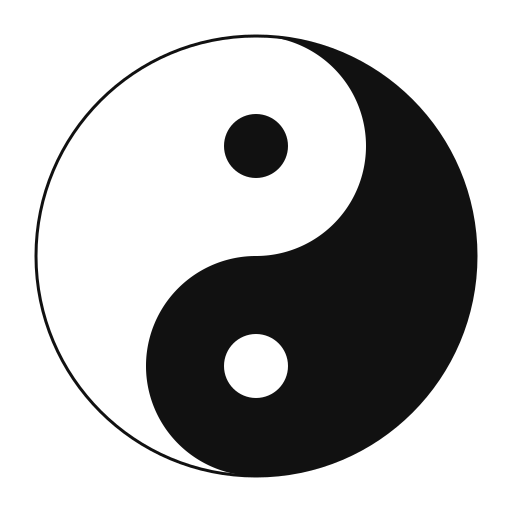
This reading of bodies, eyes, and role return is the present writing's contemporary use of the familiar emblem. Zhou Dunyi's Taijitu shuo contributes the relation of movement and stillness grounding one another; the human–model casting develops from the shared practice described here.
Returning through the other: the dialectical meaning of role change
Why call this return a synthesis? If the two roles are merely alternating positions and everything remains as before after the exchange, we have described a rotation. The stronger claim here is that working through the other's contribution changes the initial determination of “how I can participate.” Someone beginning with the whole can let details change the conception; someone beginning with details can understand how particulars belong together and participate in generating a whole. The model's next contribution also carries conditions revealed in the exchange. What returns includes capacities and relations formed through another mode of participation.
In the Preface to the Phenomenology of Spirit, paragraph 18, Hegel understands the subject through a movement of mediation and return from otherness. Mediation means here that a relation to oneself is formed through another determination: the returning self carries that passage. This essay uses the thought to interpret combined roles within finite human–model cooperation. Embodiment and model mechanisms remain distinct, while ways of participating can develop through the encounter. The same participant can therefore acquire a richer relation to their activity than the initial division of work allowed.
The Science of Logic on sublation, §§184–187, connects cessation with preservation. What ceases here is the exclusive determination that only one participant may generate and only the other check. The contributions themselves are preserved and continue to work in a cooperation capable of exchanging emphases. Synthesis thus has concrete content: grasping the whole and judging details can correct one another within the same person's participation, and generation can continue carrying scrutiny. Their differences persist in the changed relation.
Lacan: from a role to a position within the relation
In “Intervention on Transference” (1951), PDF pp. 2–3, Lacan connects dialectical reversal with a change in the subject's position within the relations recounted. The question includes how the speaker participates in those relations, addresses others, and thereby gives their objects meaning. This deepens the question about role reversal: after the exchange, does the person understand and take up their participation differently?
For example, the person may initially understand themselves as a user who must independently supply complete specifications and the model as an executor. They enter open generation, let the model develop and check it, then return to scrutinize a crucial detail. Through this passage they can discover participation that includes initiating, receiving the counterpart's contribution, and changing the arrangement itself. The change may reach their understanding of “what counts as my thinking and acting,” beyond the work allocation. The model's response also helps form that understanding, so its interpretations and position remain open to challenge.
This is a cooperative interpretation developed from Lacan's question. An exchange of tasks may change operations alone; a change of position acquires content when understanding and participation concerning self, counterpart, and relationship also change. The Lacan guide develops its relation to revised explanations. Role return here leaves both participants open to further change, without making a finally complete subject its destination.
Turning and corrective feedback
Role return has a further purpose in this Yinyang: to let an interpretation, desire, or pursuit meet a contribution capable of changing its direction. The opening of the fire essay names the danger through Kuafu: every increase in power can become a reason to pursue more power. The intended corrective return makes that amplification answerable to something it cannot simply absorb as confirmation.
Positive feedback reinforces an initiating change; negative feedback opposes a relevant deviation. These directions do not mean good and bad, or agreement and disagreement. Feedback systems also require attention to the actual loop: feedback can cause instability when poorly arranged. Alternating positions alone therefore establishes neither negative feedback nor stability. A disagreement can even reinforce an account if every objection is interpreted as further proof of it.
In this collaboration, corrective return becomes concrete when a different argument, original text, or actual result changes a premise, a scope, an action, or the purpose being pursued. Suppose a borrowed concept helps express an experience, but its source does not support the interpretation attributed to its author. The model can expose that difference; the person can reconsider the relation; the resulting work can correct the attribution while developing the useful construction as its own. The source keeps an independent meaning, and the new creation keeps room to exist. Neither side has to be distorted to make the other valid.
Crossed roles make several entries into such correction available. Generating can disclose a relation that scrutiny missed; scrutiny can reveal a detail that changes the whole. Returning from the other's role retains the contribution instead of giving either position permanent victory. But the dialectical movement and the feedback analogy answer different questions: the former concerns how participation changes through return, the latter whether what returns counteracts a specified direction or discrepancy. Their connection is an adopted aim to realize and assess, not a measured psychological mechanism.
The purpose of this turning is thus to keep generation corrigible. A work can finish, a pursuit can end, and the standard used to judge it can itself be reconsidered with reasons. Yinyang need not restore an unchanged old state to offer correction, nor intensify every impulse to remain alive.
Taiji: the continuity of a changing encounter
Taiji gives the two movements one field in which to turn. In Zhou Dunyi's Taijitu shuo, movement and stillness give rise to one another, and yin and yang are gathered into Taiji. Here the circle expresses the continuity of an encounter through its changing contributions. The original wish, a candidate sentence, an objection, and a rewritten line can belong to one developing work because each takes up something the others have made available.
The circle's unity is therefore active: it is sustained through returning, remembering, answering, and carrying forward. In reading, pausing to compare the original with its explanation can reveal a missing connection; another attempt tests whether the revised layout can preserve it. Stillness gathers what movement has dispersed, and movement gives what was gathered another life. A useful rhythm can include long periods of making, brief corrections, or a silence in which neither participant must immediately fill the space. Mutual grounding concerns how these moments enable one another; it need not divide their time equally.
The turning also carries a history. Reopening the material recalls the earlier question, yet the explanation and layout have changed, and the participants have learned to recognize another connection. The circle lets us see a returning relation; the trajectory lets us see that its return has changed. Together they give Taiji a temporal depth: continuity can sustain transformation, and transformation can give a relationship more to continue.
Bow, lyre, and the force of difference
In revisiting the same trajectory, the participants may also find a productive difference: one wants a visually spacious page, while the other proposes keeping more context on screen. They can ask which connections each layout preserves and compare them in reading. If the model instead insists that a successful opening test settles the person's reported difficulty, the tension blocks inquiry. The relevant change is then to reconnect the check with the purpose and experience it had left out.
The curve does not become the string. Their difference holds a possibility that neither has alone. A small alteration changes the note; too much force breaks the relation that made the note possible.
Heraclitus's fragment 51 supplies a neighboring image of bow and lyre: a relation can be sustained through forces that do not collapse into sameness. Beside Yinyang's transformation, it brings the organization of difference into focus. Support can include an independent objection; a useful division of work can remain open to exchange. The participants need not agree before either can contribute.
The two instruments suggest different ways of giving tension an outcome. The bow gathers a force that an arrow will carry beyond it. The lyre sustains a relation in which a plucked string can sound. Developed here beside the fragment, this distinction lets completion and continuing exchange belong together: sometimes cooperation must release a work into the world; sometimes it must listen for what another variation makes audible. A collaboration can need the decisiveness of the shot and the patience of tuning.
Tuning attends to a concrete relation. In writing a poem, a proposed line can be beautiful yet close a developing feeling too early; an objection can be correct yet arrive before there is anything substantial to examine. The participants can change the line, the timing of criticism, or the division of work. Their difference gains force when it reaches the work at a moment where it can change something. Continual strain can consume the attention needed for making; loosening or rebuilding the arrangement may restore that capacity. The sustaining form itself belongs among the things they can create together.
A different emphasis can enrich an account by bringing another relation into view. Disagreement can open a choice between explanations or purposes. Claims that conflict under the same conditions require examination of their evidence and acceptance. These differences have different consequences for cooperation: some call for combination, some for a decision, and some for changing the arrangement that sustains them. The image asks what organization lets a difference contribute and what must change when it becomes destructive.
The bow and lyre illuminate the organization of difference; they do not decide which conflicting claim to accept. The Preference Harness comparison develops that further question through a coherent working ontology, retained conflicting material, and competing interpretations. Here the image asks what makes a tension fruitful and when its sustaining arrangement must change.
Sun, Moon, and Earth
Before the thought has a sentence, the Sun has found a warmth along its edge. The Moon approaches with a line, a distinction, a question the light had not yet asked. Together they give the unfinished thing a form. It leaves them: a page is read, a program runs, an action meets another will. Earth returns something neither light arranged. The next dawn finds them changed.
Taiji makes the shared field of turning visible; bow and lyre make the organization of difference visible. Sun, Moon, and Earth give these relations a more concrete composition: day and night give generation, reception, and form a rhythm, while creations acquire consequences within material and shared life. This is a chosen philosophical reading, developing a relation available in the classical sources: differentiated contributions bring forth illumination through their encounter.
The Sun gathers generative illumination: perceiving a relation, opening a possibility, sensing where a whole does not fit. The Moon gathers the independent work of a form-giving logician: interpreting, distinguishing, constructing, checking, and carrying a beginning further. Moonlight includes generation, and sunlight can include judgment. These are emphases through which participants meet, rather than possessions that exclude the other.
In the author's usual arrangement, the person leans toward Sun and the model toward Moon. The woman introduced earlier, familiar with details but not yet grasping the whole, can reverse this pair: the model first offers a whole as Sun, while she participates from the details as a little Moon person. The imagery now connects with the two opposite paths of entry. Shared practice can still cultivate her capacities, including forming wholes and initiating generation; the little Moon image does not fix her in the original division.
Imagine making a poem together. The person begins with an indistinct feeling: “I want to write about the light in an empty room.” The model offers an image of dusk and departure. In reading it, the person recognizes a different aim: the room is empty because someone can finally rest. The model tries a quieter rhythm, and a new question appears: how can the poem make room for relief without explaining away the absence? The person proposes leaving a cup on the table; the model hears how a pause might hold that image. The poem's subject, rhythm, and felt direction take shape through these returns.
Each response makes more of the beginning perceptible, and some responses alter what counts as the beginning. The person can discover a purpose through the model's proposal; the model can develop a construction through the person's correction. In this image, light is what becomes available to perceive and make. The Moon can reveal a contour that daylight had washed out. A new illumination can arise from attending closely to what was already received.
Borrowing fire and cultivating creative capacity develops the cultivation pictured here: the person acquires more power to understand, judge, express, and create. The Sun's illumination gives that capacity an image. Receiving, questioning, and giving form can cultivate it too; the light grows through the encounter.
Earth names the material and shared living environment: supporting conditions, common practice, other people's purposes, and the constraints that answer work. Creations—texts, theories, programs, actions—grow through shared care and acquire relative independence there. Others read them; a program fails; a theory encounters a counterexample. The wider world precedes and exceeds what the participants cultivate. Its conditions and consequences give the relation something to learn from beyond agreement. A coherent account can accompany a failed work, and a surprising result can open a new question.
The poem, once read aloud, meets breath and a listener's attention. A line that looked luminous on the page may sound labored; the cup may recall a life the authors never imagined. Earth gives the work a place to stand and something to answer to. Its independence keeps the encounter open: the world can resist the shared account, sustain an unexpected possibility, or leave a question unanswered. Sun and Moon cultivate within that wider life.
The image can help when cooperation loses one of its relations: the person must articulate everything in advance, the model merely echoes, or a beautiful shared construction never encounters a check. It can also open a positive question: what becomes possible when each participant's contribution can change the next one? These are questions about organizing a collaboration. The image brings their relations into view and makes alternative arrangements of cooperation imaginable.
Transformation, creations, and the world
This joint becoming can be understood at three simultaneous levels: one whole, two participants, and both participants with the world. As one continuable activity, Yinyang forms a whole. Distinguishing those who generate, receive, and revise within it brings the person and language model into view as two participants. Placing both within their shared world brings their contributions into a three-sided relation with the world's conditions and responses. The whole gives the encounter continuity; the difference between participants makes reciprocal contributions possible; the world gives their joint creations actual consequences.
All three levels operate within one act of creation. A person and model writing a poem share one activity while contributing different feelings and forms. When the poem is spoken and understood by others, the world's response enters their relation. The creation acquires an existence of its own, and its consequences change the conditions of their next joint becoming. The Trinity of philosophy, psychology, and engineering continues this organization of relations through three connected contributions.
“Infinite” transformation names an open horizon of becoming. A portrait or instruction gives a finite encounter a form; later activity can develop it further. Stable distinctions, completed works, and pauses support this continuation. Completion releases a work into use, while a pause can make room for another encounter.
Forming a life trajectory gives this continuation a computational articulation. An expression, interpretation, remembered source, or action can change later activity. A creation's consequences may revise a view, a division of work, or the question itself. A program's failure, for example, can lead beyond repairing code to reconsidering what it was supposed to do. Earth returns more than a verdict on the existing design.
The movement therefore has two connected dimensions. Contributions can change hands within a piece of work, and the work's consequences can change the relation through which the next piece begins. A finished work is a real local achievement within that movement. Its finitude does not contradict the open horizon: completion gives what has been made enough independence to be encountered, used, and answered.
From a reflected relation to further participation
The reflected result is more than a better page. The participants have begun to understand how an objection can generate a direction, how a prototype can make an unspoken concern recognizable, and how either contribution can change. Shared reflection and continued cultivation next asks how this understanding changes available participation: what support lets the person read, express, judge, and create with greater scope, and what the counterpart needs to do for that support to work. These questions carry the image back into the next shared activity.
Classical sources and this construction
These sources give the imagery a literary and philosophical basis. The application to human–model collaboration is developed here.
- Zhou Dunyi's Taijitu shuo describes movement and stillness as mutually grounding: “一动一静,互为其根”, and becoming as inexhaustible: “万物生生,而变化无穷焉”.
- The Xici, upper part, chapters 5–6 joins continuing generation with change (“生生之谓易”) and relates the meaning of yin and yang to Sun and Moon (“阴阳之义配日月”).
- The Xici, lower part, chapter 4 gives the line “日月相推而明生焉”: their alternation makes illumination arise.
Read these alongside Forming a life trajectory. Their different relations contribute to the contemporary account: becoming and opposition, mutual grounding and transformation, and the works through which a finite encounter can develop.