 boluopai.
Writing one's own recursive improvement through literature
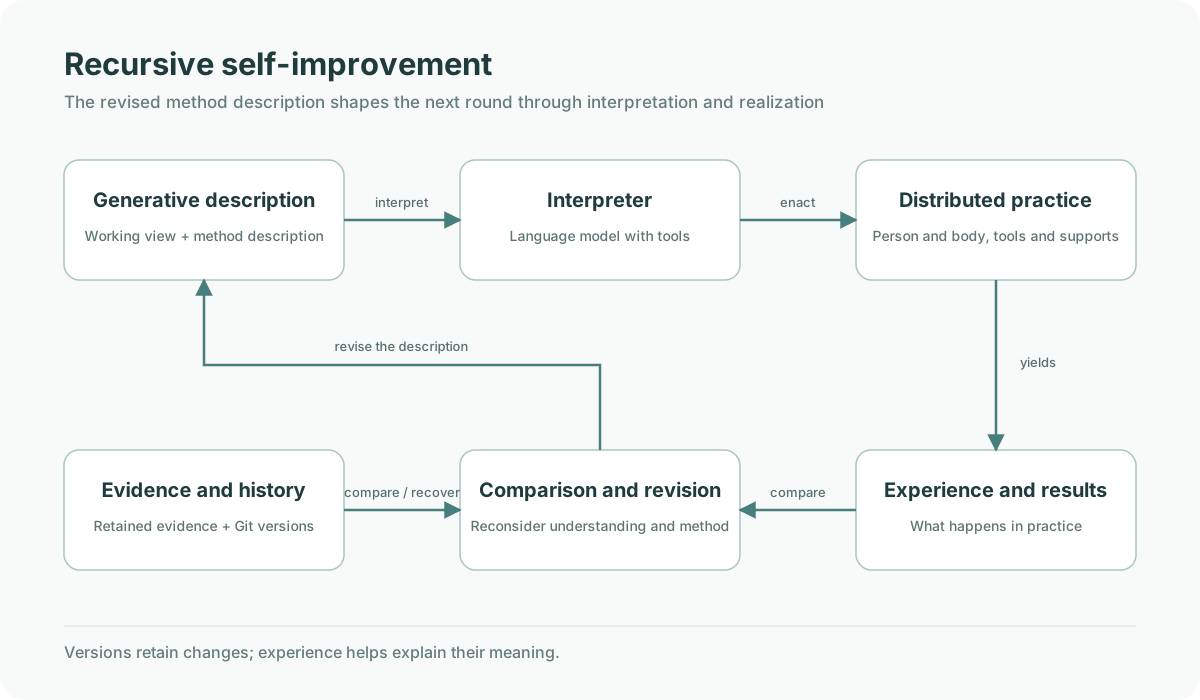
People borrow fire, create works, and change themselves through creation. Among these works another takes shape: a description of how one perceives, understands, generates, and acts. Personal philosophy gives it direction, a personal model brings it close to actual life, and a language model unfolds it into new interpretations, tools, and activities. The description continues into itself: how understanding forms, how possibilities are compared, how a change is judged worth keeping, and how these practices can themselves be revised.
Recursive improvement happens in this return: what one round of practice yields changes how the next round produces improvement. A better work gives a person a useful result; a more fitting method gives later work a new starting point; and capacities developed through repeated participation can change how the person poses questions, understands feedback, and organizes help. Yinyang expresses these connections as a personal arrangement that can be read, used, and revised.
This chapter gathers the earlier core views around a functional question: How can a system composed of person and model understand its own operation and use that understanding to improve the person's technical and living capacities, together with the methods producing those improvements? Reverse alignment supplies the developmental direction; embodied participation and listening, speaking, reading, and writing supply entrances; role return organizes joint judgment; trajectories retain grounds; reasoning organizes candidates; and the trinity connects description with realization. Together they form a functional self-model of a coupled human–model system.
Zhang, Yuan, and Zhang's paper on self-referential introspection makes introspection concrete through understanding one's own operation, simulation, evaluation, and directed modification [8]. Yinyang develops a simple version from this problem structure: the objects of improvement are the person's actual body and support relations, and the description of this practice. The model participates by helping the person understand, imagine alternatives, judge, and realize changes. Technical capacities, living capacities, and relationships with other people and the environment connect through the same practice.
Begin with self-reproduction: A, B, C, and two uses of a description
Von Neumann places the problem in an environment supplying elementary parts: how can a machine construct another with the same constructive capacity and pass on the description needed to continue construction? The constructor itself must enter the object being constructed [1].
Let $\phi(X)$ encode a machine $X$. Three modules do different work:
| Module | Function | Use of the description |
|---|---|---|
| $A$: universal constructor | Assemble $X$ from available parts according to its description. | Interpret $\phi(X)$ as construction instructions. |
| $B$: description copier | Copy the description tape. | Treat the same $\phi(X)$ as reproducible data. |
| $C$: controller | Coordinate copying, construction, attachment, and release so the new machine can continue with its description. | Arrange the passage between those two uses. |
Set $X=A+B+C$. The controller has $B$ copy the description, lets $A$ construct $X$ from one copy, and attaches a retained description to the new machine. The successor receives the complete organization
and can repeat the process. The plus signs denote composition. The same description is interpreted to construct the machine and copied to support later construction. A machine alone leaves the successor without its construction specification; a description alone still needs an organization able to interpret, copy, and realize it. Connecting the two uses supplies a concrete mechanism.
Add D: how mutation becomes heritable function
Add a module $D$ with an auxiliary function, and let the description cover all of $A+B+C+D$. The constructor can build $D$ alongside the reproductive organization, while the copier transmits its encoding. $D$ carries the additional function that reproduction can transmit; mutation is a change to a machine or its description. Each has a distinct explanatory role [1].
Suppose the part of the description specifying $D$ changes to specify $D'$, while construction, copying, and control remain functional. A successor can then have
and pass on that difference. Changing a working component while retaining the old description can instead restore the old arrangement at the next construction. Where a change occurs determines its heritability. A change that disrupts construction or control can interrupt transmission.
This opens developmental possibilities within reproduction: an organization can preserve the means of transmission while its transmitted functions vary. Use, persistence, and selection in an environment determine which variations are beneficial. Self-improvement introduces a further question: can a system actively examine consequences, select candidates, and change how it generates and selects them?
The complexity threshold: organization that can continue construction
On printed pages 78–80, von Neumann examines a tension: ordinary machines appear to manufacture things simpler than themselves, whereas living organisms produce successors of equal or greater functional complexity. His discussion concerns the complexity of purposeful operations and proposes a critical organization beyond which suitably arranged construction can continue producing equal or richer capacities [1].
A, B, C, and the encoded description make this question concrete. Continuing construction needs parts, interpretation, description copying, and successors that retain these functions. D shows how continuity can also carry variation. The threshold concerns whether these capacities form an organization able to continue. The chosen elementary parts, the environment's contribution, and the interpreter affect what must be realized.
For example, an available universal interpreter can support a short locally stored description. Including that interpreter among the objects to be reconstructed and changed also requires its construction specification. Description and interpreting environment jointly carry the capacity. The later connection between literary descriptions and language models must examine this same allocation of work and cost.
Self-reference makes a method its own object
The descriptive relation in self-reproduction can be constructed in programs through encoding and interpretation. A Quine outputs its own source; Kleene's Second Recursion Theorem supplies a more general effective self-reference. Write $\varphi_e$ for the partial function computed by program index $e$. For every total computable transformation $F$ of indices, an index $e$ exists such that
The comparison concerns computational behavior. A program can supply its own index to a given transformation and have the same behavior as the transformed program. Kleene's original account and Moschovakis's construction establish this possibility [2], [3]. Using it for improvement requires giving $F$ actual simulation, evaluation, and modification work.
With current source $e_t$, bounded simulator $f_{T_t}$, evaluator $V_t$, and modifier $M_t$, write one successor-producing step as
Simulation produces a finite execution trace; evaluation assesses it against an objective; modification produces successor source. The source also passes through the pipeline so the modifier can use it. Applying the recursion theorem above assumes total computable evaluators and modifiers, so each bounded stage returns a result. The next stage executes $e_{t+1}$. Description becomes material for examining behavior and forming candidates. Evaluation and modification can themselves be encoded, regenerated, and continued.
The introspection threshold: why the first system is foundational
In §3.4.3, Zhang, Yuan, and Zhang connect a single construction to a recursive sequence: an initial introspective system $S_0$ produces $S_1$, which continues the relevant work, yielding $S_0,S_1,S_2,\ldots$. They call the initial organization enabling this continuity an introspection threshold; Appendices A.2 and A.5 discuss uniform self-reference and its preservation under the stated editing conditions [8].
The first system is foundational because it can make itself an object of modification and pass that capacity to its successor. Producing new source leaves a further question: how will the new version recover its own description, use its evaluation and modification methods, and produce another executable successor? Recursion must realize this continuity too. The initial construction establishes the organizational conditions in which later changes can occur.
Evaluation, modification, and simulation horizons can also become objects of change. An old system might compare only speed; its successor adds error checks; another iteration finds that simulation omitted actual inputs and improves the simulator. These changes concern task performance, evaluative capacity, and the method producing improvements. Including the last of these gives content to strong RSI's improvement of the capacity to improve.
The threshold poses an architectural question: what organization can sustain this self-referential modification chain? Continuing gains pose evaluative questions: does a candidate improve the objective, does simulation predict actual effects, and is further search worth its cost? The paper frames its threshold thesis as a conditional conjecture; realized gains depend on these conditions. Schmidhuber's Gödel machine further uses formal proof to compare the utility of modifying now with continuing the search, incorporating opportunity cost [4]. Structural continuity and worthwhile improvement become connected questions.
What completeness, functional properties, and structural properties establish
The paper's §3.5 distinguishes three levels. Completeness concerns the range of modification, functional properties concern what a system can do, and structural properties concern how those functions are organized [8]. Applied to the present question:
| Level | Central question | Contribution to continued improvement |
|---|---|---|
| Completeness of self-modification | Can task code, parameters, and the modifying mechanism itself all become reachable objects of change? | Methods can change themselves; reachability and selection of a beneficial path are examined separately. |
| Self-modeling, self-simulation, self-evaluation, self-modification | Can the system describe its operation, explore candidates, compare predictions with outcomes, and bring changes into execution? | Understanding itself connects with changing itself. |
| Reflexivity | How does an executing organization correspond to its generative description? | A changed description can reconstruct a corresponding successor organization. |
| Recurrent processing | How do successor results become the next stage's inputs and conditions of modification? | One construction becomes an activity that can continue. |
Completeness here concerns the space of self-modification. Appendix A examines finite viable paths and changes to different code regions. The cost of finding beneficial paths and the reliability of evaluation require their own analysis. For a continuing chain, examine whether intermediate versions retain introspection and how control passes to a prepared successor when the mechanism doing the modifying is updated.
Reflexivity connects description with execution; recurrence lets that connection repeatedly participate in operation. Descriptions require actual encoding, interpreters, and supporting environments. Including more functions in the modifiable unit increases the relations that must be expressed and realized; borrowing existing environmental capabilities lets shorter descriptions do richer work. We can now bring these distinctions into human–model practice.
Body, generative description, and interpreter
We now connect these relations to Yinyang. The chosen unit of improvement is a person together with the model and their actual support relations: the body participates in life; descriptions make relevant operation understandable and revisable; interpretation and realization bring changes into subsequent activity. Within this ongoing practice, distinguish three functions:
| Function | What it bears in Yinyang | How it produces subsequent consequences |
|---|---|---|
| Body $B_t$ | A person's senses, actions, habits, and capacities, together with devices, records, tools, and counterparts that continually support activity. | Perceives, participates, acts, learns, and bears consequences. |
| Generative description $\Delta_t$ | Philosophical direction, understanding of the person and counterpart, their relationship, environmental arrangements, and methods of revision. | Enables participants to understand, unfold, and reorganize the practice. |
| Interpreter $I_t$ | A process of interpretation and realization centered on a language model and equipped with actual tools. | Forms plans from the description and current situation, constructs works, and adjusts the environment. |
Body here has a distributed practical meaning. When a capacity is maintained jointly by a person's judgment, a model's elaboration, available tools, and records one can return to, we understand it along those actual connections. The person's body is the center of life and the entrance to feeling and action; the model makes more expression, comparison, and construction available as contributions. As support, the model belongs to this organization, and in reading and unfolding the description it also serves as interpreter.
A generative description expresses relationships that can continue to be unfolded. For example, “a counterpart who unfolds a question together with the person” can lead to investigation, formation of candidates, making, checking, and revision. New situations have not yet been listed individually, but the relationship already gives the model a direction for interpreting them. On seeing the result, the person may also reconsider how that sentence should be written. Both participate in interpretation, and engineering supplies actual means for the parts that need to be enacted.
The trinity of philosophy, psychology, and engineering thus acquires a set of technical connections: philosophy develops the description and its reasons, psychology understands the activity of embodied participants, and engineering organizes interpretation and realization. The three change one another along the same practice.
Six perspectives form one functional self-model
The self-model concerns the human–model system that is currently understanding, judging, and acting together. The person's philosophy already includes how they understand themselves and relate to models and other people; the model uses these descriptions to adjust its contribution. Description therefore both represents the system and participates in its operation. Introspection happens when participants use this description to examine their own inputs, interpretations, choices, actions, and consequences. Both participants, records, and tools can share this work.
The six working accounts unfold this object through six connected perspectives:
| Working account | Relationship the self-model needs to explain | Contribution to a change |
|---|---|---|
| Orientation | What is worth developing and which gains and costs matter. | Selects substantive purposes for evaluation and lets consequences in life reopen them. |
| Person | How the person perceives, expresses, learns, and acts, and which conditions make capacities available. | Anticipates what participation a change would enable and what actual attempts it requires. |
| Counterpart | How the current model receives material, reasons, generates, uses tools, and fails. | Judges what it can undertake and which judgments still need human experience or other evidence. |
| Relationship | How contributions continue, exchange, correct one another, and return. | Compares how different divisions of work affect understanding, judgment, and action. |
| Environment | Through which interfaces, materials, devices, and social conditions descriptions take effect. | Locates realizable changes and entrances for actual feedback. |
| Revision | How candidates form, consequences are simulated, results evaluated, and the system modified. | Keeps these practices and the revision method itself available for improvement. |
The six perspectives jointly perform introspection. A difficulty in reading may involve the person's conditions of participation, the model's interpretation of the request, the interface, and the original completion criterion. Reading along these connections yields an understanding of one operating process. Person, counterpart, and relationship accounts constrain one another: human change alters the counterpart needed; new model capabilities alter the division of work; and that division and its environment alter actual human participation.
Functionality requires the description to help answer “How does this work under these conditions, and what would changing this affect?” Fidelity requires checkable correspondence between those answers and actual operation. The description retains distinctions that change the present judgment: sound or transcription, difficulty understanding or initiating action, original source or summary, a saved edit or an edit actually in use. Natural language, examples, tables, and local mathematical models can all contribute; the contemplated change determines the needed precision.
For example, “This person needs clear explanations” gives too little guidance. “They can identify relationships in a diagram, but reconstructing references across long passages takes considerable effort; presenting related objects together is expected to help them identify omissions” supplies conditions, a candidate relationship, a change, and observable consequences. Comparison may support it or locate the difficulty elsewhere. Uncertain causes remain candidates, allowing the self-model to keep learning.
How modeling, simulation, evaluation, and modification work
The self-model makes the current process intelligible; simulation unfolds candidate changes into possible processes; evaluation compares those processes and actual results; modification brings selected relationships into the body, description, or supporting environment. These four capacities can interleave within one conversation and act of making.
| Capacity | What happens in practice | What remains available for the next occasion |
|---|---|---|
| Modeling | Recover purposes, inputs, participants, states, conditions, and dependencies from concrete activity; compare explanations. | A working understanding that explains decisive differences and locates possible changes. |
| Simulation | Explore “What if we changed it this way?” under stated conditions, using scenarios, role rehearsal, sketches, prototypes, or executable models. | How a candidate would work, where it might fail, and expectations that distinguish candidates. |
| Evaluation | Compare expectations with observation, considering participation, gains, maintenance costs, and consequences borne by others. | Reasons to adopt, modify, retain, or abandon an arrangement. |
| Modification | Rewrite descriptions; change tools, interfaces, materials, roles, and actual practice; observe successor activity. | A usable successor arrangement and corrections to the self-model and improvement method. |
Simulation can begin qualitatively. Two reading entrances, practice methods, or divisions of work often already have comparable differences; actual trials can then test the decisive expectations. A model-generated scenario develops a possibility, while the person's and world's responses establish how it is realized here. Runnable programs and tools permit direct experiments; changes in human learning and life require calibration through the person's activity, experience, and subsequent results.
This model has mathematical and physical aspects. Mathematics expresses relationships, conditions, inferences, and local state changes; physical realization gives perception, computation, action, time, and resources their actual consequences. Person, model, and tools change at different rhythms: an interface can update immediately, proficiency develops through use, and a new social arrangement needs other participants' responses. An account of the coupled system connects these rhythms.
Recursion occurs when the four capacities themselves become objects: how relationships are selected, how simulations are generated, what evaluation overlooks, and why a modification failed to take effect can all improve through the practice. A more accurate model can improve the next simulation; failed expectations can revise modeling; implementation difficulty can change candidate generation so that later work considers actual entrances earlier. The object improved is therefore the human–model system's capacity to improve the person's living and technical capacities.
Listening, speaking, reading, and writing as interfaces for introspection and change
The division of work across listening, speaking, reading, and writing brings these functions into ordinary activity. A person can begin with intuition, sound, a sketch, criticism, or an unfinished utterance; the model unfolds relationships, checks details, and maintains works that can continue. The table considers different entrances into the same activity:
| Entrance | How material about one's own operation becomes available | How it contributes to improvement |
|---|---|---|
| Listening | Recognize meaning and mismatch in explanation, sound, rhythm, and hearing oneself speak. | Compare how explanations reach oneself; adjust presentation, examples, or communication. |
| Speaking | Express wishes, intuitions, predictions, and objections, discovering relationships through expression. | The model reconstructs candidates, which further human expression can correct. |
| Reading | Read sources, diagrams, one's own descriptions, and works; compare what is said with what is encountered. | Examine fidelity to activity and differences before and after a change. |
| Writing | The person writes ideas, philosophy, and decisive judgments; the model develops and maintains arguments and implementations. | Put new understanding into readable, usable descriptions for subsequent activity. |
These entrances can repeatedly connect. A person encounters an inaccessible explanation and voices a counterexample; the model reconstructs the relations and draws a candidate; the person listens, checks an omission, and revises the earlier understanding. Role return in Yinyang dialectics gains technical content here: generation, scrutiny, and revision recur through the other's contribution, and the original division of work can change. Actual input channels determine what each participant can judge from.
Existing capabilities distribute the technical work: language models organize material, unfold possibilities, write, and implement; memory and version tools support return; specialist tools handle relevant computation and measurement; people change their activity through participation, experience, judgment, and practice. An initial implementation can be simple: maintain six connected descriptions, use them in a real task, and connect expectations, results, and reasons for revision to the relevant accounts. Existing tools handle preservation and delivery. Concrete uses can later justify additional simulation or measurement.
Self-referential introspection and the Gödel machine: the reach of the argument
The introspection paper connects reading one's own description, bounded simulation, evaluation, and modification in a program construction, and examines complete rewritability and Gödel-machine correspondence in Appendices A–C [8]. Its direct contribution to Yinyang is to make a functional self-model participate in actual selection and modification, with the simulator, evaluator, and modification method included in the description. The person belongs inside the coupled system under consideration, so human judgment can be part of the system's own judgment.
This supports a concrete conditional argument: when a description faithfully represents the relevant functions, participants can use it to form and compare modifications, selected modifications actually change subsequent activity, and results return to the self-model, the system has functional introspection and directed self-modification. When changes improve its later capacity to model, simulate, evaluate, or modify, they provide practical grounds for recursive improvement. Self-reference is a traceable causal relationship here: the method in use processes its own description, and the successor method carries forward the result. It shares the Gödel machine's concern with improving the improvement program and includes the cost of continuing search in comparison.
The paper's strict conclusions have stronger premises that need separate treatment:
| Condition or conclusion in the paper | Correspondence and unresolved proof obligation in coupled practice |
|---|---|
| Self-containment H1 | The system obtains its source description internally. Taking person and model together can internalize material they provide one another; complete source self-supply still requires demonstration. Belonging to one natural world is a different claim from this formal condition. |
| Directedness H2 | The system computes and selects modifications from accessible data, including external input. Reasoned human–model comparison can supply directed selection; correctness of each choice needs separate evidence. |
| Complete directed self-modification A6 | Any source region can receive any prescribed content while the capability to continue modification survives. Human bodies, model weights, platforms, and physical conditions have actual access limits; this practice currently has no completeness proof. |
| No internally immutable region | The paper derives this from its complete rewriting construction. Practice can reopen all six descriptions and their revision method; actual modification capabilities establish that scope. |
| Rewrite equivalence with a Gödel machine | Appendices B–C use specified axioms and utility, a proof-checking evaluator, and a proof-search modifier, matching rewrite events and intervening input–output behavior. This practice uses empirical models, limited simulation, and human judgment; those formal components and equivalence proof have yet to be realized. |
The result here is an argument for human–model practice with a self-referential improvement structure. Runnable local constructions and actual activity can progressively strengthen it. Gödel-machine global optimality requires its particular formal conditions; the introspection paper's proposed threshold has no quantified, empirically validated value for this practice. A sufficient initial aim is an increasingly faithful self-model for relevant uses that actually improves the four capacities.
“Written down and hardcoded again” identifies an implementation problem: a file may be editable while the categories, evaluation criteria, or modification routes interpreting it remain outside reflection. Addressing this requires making those relations identifiable, comparable, and replaceable, and bringing changes into the next use. A current version's definite wording supplies a checkable object; making that version material for subsequent practice preserves openness. Continuing change is judged by use: an effective method can stabilize and later change in response to a new counterexample.
Retaining conflict and forming a view for action
Improvement requires seeing possibilities beyond the current arrangement. A failure, reports from different people, and an earlier abandoned proposal may point to incompatible explanations. Retaining them as material for comparison allows the current description to continue encountering difference. Action also requires sufficiently definite grounds: what object is to be addressed, which relations matter, and what predictions and choices follow?
The earlier essay's working view answers the latter questions. It organizes relevant material, candidate explanations, adopted premises, and ways of reasoning for the current problem. Retained sources are broader; the working view makes grounded commitments from them. Explanations not currently adopted remain available for comparison and can return when new results appear.
Inconsistency-tolerant semantics provides a precise local example of this distinction. Fix general axioms $T$; select subsets of conflicting assertions $A$ that are consistent relative to $T$ and maximal under inclusion, and the result is a set of repairs. The adopted query semantics then determines how answers are obtained across repairs. Under an answer rule requiring support in every selected repair, a conclusion can hold amid unresolved conflict [6].
For example, suppose $P$ and $N$ are mutually exclusive, both entail $Q$, and the material contains both $P(a)$ and $N(a)$. Either consistent basis yields $Q(a)$. This shows how to obtain a local conclusion robust across these alternatives. If further inquiry finds the classification relations unsuitable for the current object, $T$ itself needs reconsideration; changing the classification, axioms, or answer rule forms a new question of inquiry.
Here inconsistency tolerance meets recursive improvement. Local reasoning produces a result under selected relations; reflection also makes the way those relations are selected an object. The participants can modify the scope of material, methods of generating candidates, priorities among sources, conditions for accepting conclusions, and concepts that organize the whole question. Each modification has its own reasons: new facts can change a judgment, a new purpose can alter a practical trade-off, and a new interpretation can reconstruct the original options.
From rewriting words to changing the next activity
Writing a method into a description makes it identifiable and modifiable. How it actually works also takes shape through the model's understanding, tools, a person's habits, and current conditions. “Compare two options,” for example, must be unfolded into which outcomes to compare, how to obtain them, which differences would change the choice, and who undertakes the comparison. These concrete activities can themselves be revisited.
A set of working notations gathers the relationship:
$\Delta_t$ is the current description, $B_t$ the embodied participation and support conditions at that time, and $I_t$ unfolds them into activity $A_t$. The activity encounters the world $\Omega_t$, bringing actual participation and environment into a subsequent state $B_{t+1}$ and leaving experience and results $E_{t+1}$ available for understanding. The notation expresses dependencies to investigate; a particular study must explain which changes occur, how, and how they can be observed.
Revision brings these results back into the description. Let $R_t$ be the revision method actually used at the time, and $\Delta^R$ the part of the description concerning revision:
The first step compares current understanding with relevant experience and writes a successor description. The second brings its method into the next round of work through interpretation and actual organization. The method in the description may be rewritten first, software may update relatively quickly, and a person's habits may form gradually over many activities. Each change follows the rhythm of its actual realization.
The reflexive relationship lies between these two steps: a revision method participates in modifying the description of itself, and the revised description, once realized, changes later revision practice. New words offer a candidate that can be realized; subsequent selection of material, comparison, judgment, and action show what function it has acquired.
How one reading changes the way reading is improved
Continue with the hypothetical reading environment from the earlier essay. A person wants to resume reading easily. The model organizes a bookshelf and checks the result by asking whether the selected book can be opened. The correct book does open, yet the person still has to find the previous passage and reconstruct the argument just followed. The operational result and the reading experience together clarify the problem: opening the book is one step, while resuming understanding also requires recovering a thread.
The participants can retain two candidates. One holds that the destination is wrong; the other that the original check covered only part of the purpose. Inspecting the actual page can examine the first explanation; once the book is found to be correct, the course of reading helps illuminate the second. The sources retain the original request, the version actually opened, the person's response, and the checking process; the current working view uses them to select the next modification.
The first modification returns the page directly to the relevant passage, and its effect is examined during reading. Git retains the original bookshelf and the later entry point, while feedback from use explains why the difference matters. If the new arrangement makes reading easier to resume, it provides grounds for claiming an improvement to this work.
The recursive next step is to rewrite the improvement practice as well: when modifying a reading environment in future, first recover the activity the user wants to continue, then select acceptance checks from that activity. Guided by this method, the model identifies a return point to preserve earlier in another reading task, and the participants can more easily form a fitting arrangement. Subsequent work then provides grounds for judging the method improved.
Further use may reveal that new reading calls for an overview, while resumed reading calls for direct access. The participants therefore retain both entry points and explain the activity each serves. An idea previously set aside in favor of the current proposal becomes part of the reconstructed arrangement. “Keeping hold of the thread” can condense these relationships; examples, conditions, and realization continually enrich its meaning.
The example connects three kinds of result:
| Object improved | How it appears in the example | Where subsequent grounds come from |
|---|---|---|
| Work | The page supports return to the needed passage. | How this page works in actual reading. |
| Method | Checks are selected from the activity to be continued. | How later related tasks produce fitting arrangements more effectively. |
| Capacity | The person and supporting environment can more readily recover, understand, and continue reading. | The activities they can subsequently initiate, judge, and sustain in practice. |
These results can support one another and can also appear at different speeds. Support that remains available can itself become part of a person's distributed capacity.
How evaluation continues to develop
Improvement requires something worth improving. Personal philosophy supplies a direction for life, particular tasks unfold that direction into comparable outcomes, and methods organize how those outcomes are obtained and understood. Evaluation therefore also has content that can be revised.
In the reading example, changing “can open the book” to “can resume understanding” corrects a proxy under the same purpose in life. A later wish to preserve opportunities to explore unfamiliar material may change the trade-off: some navigation helps form an overview, while other steps are the burden of repeatedly recovering context. Later still, the person may reconsider how much to invest in reading, creation, and rest. Revision can occur at the distinct positions of checks, means, and ends.
By connecting the original direction, difficulties encountered, reasons for change, and later results, changes in evaluation acquire an intelligible continuity. The participants can explain what a new standard sees, what the earlier one missed, and what gains and costs the new choice brings. The model contributes comparison, explanation, and realization; the person contributes lived experience, direction, and judgment; the world supplies further material through use of the work and responses from others.
This gives “better” a concrete meaning. It may mean noticing important differences more readily, forming more intelligible judgments, spending less effort repeatedly recovering context, realizing a wish more reliably, or being freer to change a pursuit that no longer fits. Recursive improvement thus serves a life and can also enrich the interpretation of values through which that life is organized.
Git/GitHub: making change comparable and continuable
Both literary description and its engineering realization can retain versions. Git makes a change to text or code an inspectable difference; GitHub lets selected public works be read, discussed, and developed further. Connecting records with versions lets the model return to the understanding adopted at a time and compare what happened later.
| Version operation | Contribution to recursive inquiry |
|---|---|
| Save a commit | Retain a description or realization as a definite object for later comparison. |
| Inspect a diff | Show which relationship, method, or code changed. |
| Develop a branch | Give an alternative arrangement worth trying a place where work can continue. |
| Merge and reconstruct | Organize selected contributions into the next arrangement actually used. |
| Return to an earlier version | Recover old material under new conditions and form a new choice. |
These are means of retention and construction. One file can contain several candidate explanations, and one explanation can be expressed jointly through several works. The meaning of the writing and actual use show which view is adopted; version relationships locate how these expressions formed. Connecting reasons for choices with relevant experience allows version history to help explain the meaning of a revision.
A recursive loop and a directed acyclic commit history can both hold. The loop describes a functional relationship that repeatedly returns: a work puts a method to the test, and the method changes the next work. The history records each return as a later event: the first modification, first use, and second revision each have their own place. Returning to a question produces a new event; adopting old content again can also form a new commit. Git's parent–child edges record version ancestry [7]; the meaning of reflection comes from the actual connections among versions, reasons, and consequences.
Descriptions of how to revise methods can enter the same history. The participants can compare how material was selected before, why that changed, and whether the change took effect in the next work. Public philosophy, private understanding, and records of actual use each reside in suitable places; shared inquiry connects them according to the question. Website, repository, and local environment respectively support reading, maintenance, and operation, making self-description work that can be continued.
The benefits of condensation come from existing interpretive capacity
Literature lets an image organize many connected activities. “Borrowing fire” connects acquiring capacity, cultivating oneself, and continuing to create; “keeping hold of the thread” connects returning to a place, recovering context, and resuming understanding. Readers unfold a short phrase because language, culture, examples, and shared experience already participate in their understanding.
Discussing genetic descriptions, von Neumann paid particular attention to how a description operates in an already organized environment: sometimes it need only provide cues for selection and triggering, with existing organization doing much of the work [1]. This helps illuminate the cooperation of a short description and a capable interpreter. Yinyang's literary expression likewise entrusts much of the unfolding to participants who already possess knowledge and contextual understanding.
The benefits of condensation must be assessed across the whole practice. Easier writing and maintenance are one benefit; faster recovery of shared direction by the model is another; the costs of interpretation, checking, and repair also enter the account. A phrase that reliably recalls fitting relationships can reduce coordination among scattered instructions; when a new distinction needs elaboration, longer writing, examples, and original material provide room for continued understanding.
Good condensation therefore has both organizing and unfolding power: it can bring practices in different places back into one relationship, and can elaborate its reasons and conditions where they matter. It retains distinctions that would change judgment and entrusts other details to the interpreter and environment currently able to bear them. Revising a set of core relationships can consequently change many related activities together.
This also shows where complexity resides. A description can be concise because interpreter, body, tools, and shared history bear other organizing work. The question is whether this division of work can continue at an affordable cost and whether, when a new problem arises, the relevant relationships can be found and changed. Literature thus becomes a practical means of revision: easy to return to, easy to rewrite, and capable of generating new arrangements.
Developing with a changing interpreter
Advances in language models change what contributions a description can elicit. The same philosophical relationship may be unfolded by a more capable model and new tools into works previously difficult to realize. By recognizing this possibility, selecting and connecting capabilities, and rearranging collaboration, the person–model community turns external progress into its own working conditions.
This is one concrete form of reverse alignment. The person develops an understanding of how to create together with generative capacity; the model adjusts its contribution according to the personal description; and both reconsider who undertakes what. Work that previously needed item-by-item specification can gradually be entrusted to clearer purposes and relationships, giving the person's attention an opportunity to enter new perception, comparison, and creation.
External model upgrades and local development of methods support each other in the same practice. When explaining an improvement, retaining the models, tools, materials, and conditions of participation involved helps clarify which capacities came from new support and which relationships formed through shared work. The person's body, habits, and environment each change at their own pace; the personal description connects them in a time to which the participants can continue to return.
Yinyang's RSI therefore centers development on this person and their actual relationships of support. Literature makes self-understanding a readable work, philosophy explains why to cultivate in this way, model and engineering give it function, and embodied experimental philosophy lets consequences continue to participate in the argument. Creation changes the work and the creator; when that change further improves how the next round learns, judges, and creates, recursive self-improvement acquires its own practical content.
Sources and their contributions
- John von Neumann, edited by Arthur W. Burks (1966), Theory of Self-Reproducing Automata, Lecture V, printed pp. 75–87. Pages 75–77 discuss components and environment; pp. 78–80 the critical size of complication; pp. 84–85 the A/B/C reproductive organization; pp. 86–87 D and heritable variation; p. 79 and the later discussion connect descriptions with existing organization. Public scan. This chapter develops a functional comparison of description and supporting environment from that account.
- Stephen Cole Kleene (1938), On Notation for Ordinal Numbers, §2, printed p. 153. DOI. Effective construction using one's own index as a parameter.
- Yiannis N. Moschovakis (2010), Kleene’s Amazing Second Recursion Theorem, theorem statement on printed p. 190, and §1, Theorem 1.1, pp. 192–193. Author's full text. Concrete constructions of effective self-reference and output of one's own description.
- Jürgen Schmidhuber (2006, v5), Gödel Machines: Self-Referential Universal Problem Solvers Making Provably Optimal Self-Improvements, §4.1, Theorem 4.1 (printed p. 11), §4.3 (p. 12), and §6.1 (pp. 15–16). Version read. The utility comparison includes the opportunity cost of continued search, and modification may concern the improvement program itself. This chapter borrows that problem structure to develop a person–model method grounded in interpretation, practice, and subsequent results.
- Roman V. Yampolskiy (2015), From Seed AI to Technological Singularity via Recursively Self-Improving Software, §§1–2, PDF pp. 2–4. Paper. Distinguishes self-modification, improved performance, and change in capacity for subsequent improvement.
- Meghyn Bienvenu and Camille Bourgaux, definitions of repairs and query semantics, §3. Author's version. This chapter follows the local formal example in the preference essay, then examines how such selection rules themselves become objects of revision.
- Git project, Git Glossary, entries including DAG, commit, branch, and merge. Official glossary. Version ancestry gives technical meaning to historical location; actual materials establish the connection between versions and consequences in life.
- Jiang Zhang, Bing Yuan, and Qian Zhang (2026), Self-Referential Introspection in Large Language Models: The Critical Threshold for Recursive Self-Improvement, v2, 2026-09-18, §§3.3–3.4 and Appendices A–C, especially H1/H2 and Definitions A6, A8–A11. Version read. The paper proposes a program construction for reading one's own description, simulation, evaluation, and modification. This chapter develops a coupled human–model version from its functional questions and distinguishes its practical argument from the premises needed for the formal conclusions.